
Dr Peter Dickinson, Consultant Clinical Oncologist | Lung cancer, Stereotactic Radiotherapy, oligometastatic disease and mesothelioma
Dr Peter Dickinson is a Consultant Clinical Oncologist based in Leeds. He has spent over 20 years in cancer medicine and has worked as a Consultant at Leeds Teaching Hospitals NHS Trust since 2013. He qualified at the University of Nottingham Medical School, completed his specialist training in Clinical Oncology in Nottingham, and held a radiotherapy research fellowship at The Christie Hospital in Manchester.
In 2023, Dr Dickinson joined GenesisCare UK as a Specialist Advisor to the SABR Clinical Reference Group, and in October 2025 was appointed Clinical Lead for the new Elekta Unity MR Linac service at GenesisCare Leeds. He sees private patients in Leeds, with telephone and video consultations available UK-wide. As an MR Linac specialist, he offers advanced treatments including re-irradiation SABR for cancers recurring in previously irradiated areas — a setting where careful planning and specialist expertise matter most.
Cancer care works best when you are treated by a consultant who specialises in your particular cancer. Dr Dickinson's practice focuses on three areas in which he has developed extensive expertise over more than a decade.
Cancer often moves from where it started to affect other parts of the body. A precise and high dose radiotherapy technique called Stereotactic Radiotherapy (SABR) can be used to treat sites of cancer spread.
‘Oligometastatic disease’ describes cancer that has spread beyond where it started, but only to a small number of sites - usually five or fewer. It sits between fully localised cancer and widespread metastatic disease. For carefully selected patients, targeting every visible site of disease with stereotactic ablative radiotherapy (SABR) can achieve long-term remission, and in some cases, extend life.
Whether this approach suits you depends on your primary cancer type, the number and location of the sites of cancer spread, your previous treatment history and how your disease has behaved so far. SABR can also be used to treat small areas of cancer that are not being controlled by chemotherapy and immunotherapy. Patients may then have the opportunity to continue with systemic therapy, which is controlling cancer elsewhere. SABR can also be used as the most effective radiotherapy technique to reduce pain caused by cancer, in areas such as the spine.
Dr Dickinson helped set up the stereotactic radiotherapy service for metastatic cancer in the NHS in Leeds. He also lead the MR Linac service at GenesisCare Leeds - which delivers one of the most advanced forms of radiotherapy currently available in the UK.
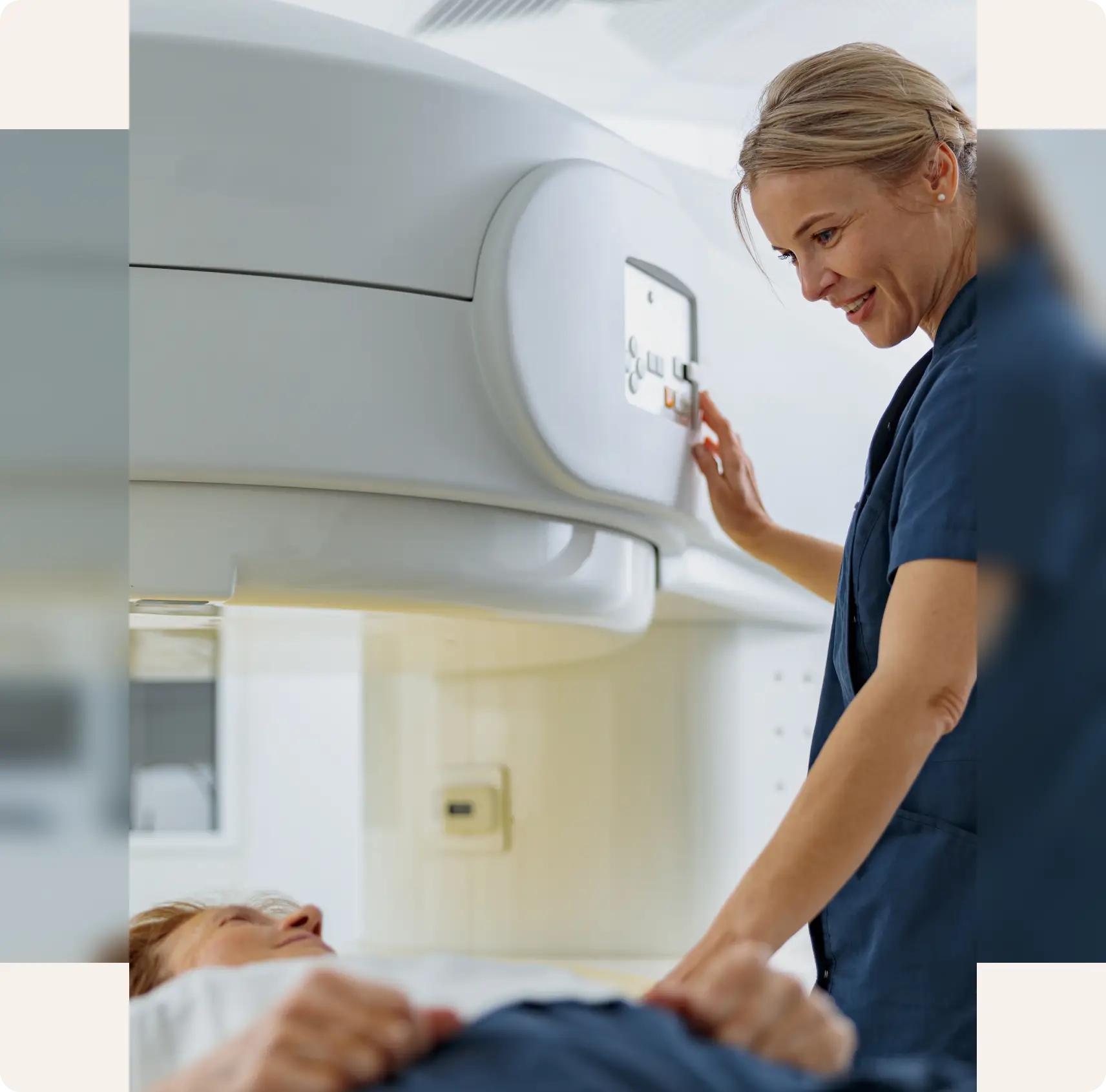
Lung cancer has been Dr Dickinson's clinical focus for over a decade, and there have been huge advances in both radiotherapy and systemic therapy treatment options. Increasingly, the best treatment outcomes are achieved by combining treatment modalities, and Dr Dickinson is able to offer all non-surgical options.
Dr Dickinson treats patients with both non-small cell and small cell lung cancer. Where appropriate, he can offer radiotherapy to patients who have received radiotherapy previously - this is called ‘reirradiation’.
For early-stage non-small cell lung cancer in patients who aren't fit for surgery, or who do not wish to have an operation, SABR delivered in 1 to 8 sessions over 1 to 3 weeks can achieve cancer outcomes comparable to surgery.
When an early lung cancer sits close to the heart, oesophagus or major airways, Dr Dickinson is able to offer patients stereotactic radiotherapy on an MR linac. By using this advanced technology he is able to maximise dose delivered to the cancer and reduce the risks associated with treatment.
Dr Dickinson chose to lead the MR Linac service at GenesisCare Leeds to benefit patients whose cancers are challenging to treat from a technical perspective - tumours sitting close to important normal organs, tumours which move within the body and tumours that lie in areas of the body previously treated with radiotherapy.
For more advanced lung cancer, Dr Dickinson creates personalised treatment plans for patients, choosing chemotherapy, radiotherapy, targeted agents and immunotherapy, depending on a cancer’s specific characteristics and a patient’s individual circumstances and wishes.
Dr Dickinson offers second opinions to patients receiving treatment elsewhere - it carries no criticism of your current team, gives you confidence you have heard every option, and patients can find it useful and reassuring to have their case reviewed and have the opportunity to ask further questions.

Mesothelioma is an uncommon cancer linked to previous asbestos exposure, with around 2,700 people diagnosed in the UK each year. It affects either the pleura (the lining of the chest) or, less commonly, the peritoneum (the lining of the abdomen).
Treatment has changed significantly in recent years. A trial showed the benefit of a combination of immunotherapy as a first treatment for pleural mesothelioma. The right combination of systemic therapy, radiotherapy and occasionally surgery now depends on the type of your cancer (epithelioid, sarcomatoid or mixed), how advanced the cancer is, a patient’s symptoms and overall fitness.
Mesothelioma care should never sit with one clinician alone, which is why Dr Dickinson works closely with thoracic surgeons, respiratory physicians, clinical nurse specialists and palliative care colleagues..
Some patients with mesothelioma are able to use their industrial compensation package to access treatment which is not available on the NHS, and Dr Dickinson is happy to discuss all treatment options with all patients.

The situations below are where Dr Dickinson's experience is most relevant - if one of them sounds like yours, please get in touch.

Modern cancer treatments are precision tools. Dr Dickinson chooses the most effective treatment or combination of treatments for any given cancer, tailor options to meet an individual patient’s wishes, and take into account their personal circumstances and other health conditions. Below are the four approaches he uses most commonly, and the situation each one is best suited to.
Receiving a cancer diagnosis or seeking a specialist opinion can feel overwhelming, and understanding what comes next is often the first step toward feeling more in control. The outline below sets out the four stages of a typical patient journey under Dr Dickinson's care, from your initial enquiry through to the treatment plan.
Once you have made an enquiry, the practice team will be in touch within two working days to arrange your first appointment at a time that suits you.
To help make the most of your consultation, it is useful to provide any referral letters, recent scans and reports in advance. If these are not readily available, Dr Dickinson can request them directly from your hospital or referring doctor with your consent.
You are welcome to bring your partner, a family member, or a friend to your consultation. Many patients find it reassuring to have someone with them to listen, take notes, and help ask questions. There is plenty of time during appointments to discuss your situation without feeling rushed.
Dr Dickinson will review your medical history, scans, and test results in detail and explain his assessment and recommendations in clear, straightforward language. There is always time to ask questions. Consultations take place at Nova Healthcare at St James's University Hospital in Leeds. Telephone and video appointments are also available.
Dr Dickinson believes in having clear, honest, and evidence-based conversations about your treatment options. Together, you will review all the approaches that may be suitable for your situation, including advanced treatments such as stereotactic radiotherapy (SABR), MR-guided radiotherapy or systemic therapy.
Dr Dickinson will explain the potential benefits and risks of each option, as well as how treatment may affect your day-to-day life. This allows you to make an informed decision that feels right for you and those close to you.
Written information will be provided to help you understand and reflect on any treatments discussed during your consultation.
After your consultation, Dr Dickinson will provide a clear written summary of what has been discussed, including any recommended next steps, further tests that may be needed, expected timescales, and information about costs where relevant.
You will also be given direct contact details for Dr Dickinson's team, so that you have someone to turn to if questions or concerns arise between appointments.
If a treatment plan is agreed, we will begin making the necessary arrangements before you leave the clinic whenever possible. This helps ensure that you have a clear plan and can move forward with confidence, knowing what happens next

Dr Dickinson is recognised by all of the leading UK private medical insurers, including Bupa, AXA, Vitality, Allianz, WPA, and Cigna. If you hold private health insurance, your policy will typically cover your consultation and treatment in full, subject to the terms of your individual cover. Before your first appointment, it is recommended that you contact your insurer to confirm specialist oncology benefits and to obtain a pre-authorisation code.
For patients choosing to fund their own care, you will receive a clear written estimate of fees before any appointment or treatment is booked, so there are no surprises at any stage. If you are unsure whether a particular treatment is covered by your policy, or whether pre-approval is required, the practice team is on hand to liaise with your insurer on your behalf and confirm the position before your first appointment.









Below are the questions patients and their families most commonly raise before a first appointment. If yours isn't covered here, please get in touch.
You do not need a GP referral to arrange a consultation and are welcome to contact Dr Dickinson’s practice directly. If you have a referral letter please forward this to the team, as it will provide helpful background information ahead of your appointment.
If you have private medical insurance, it is worth checking your policy before booking. Although a GP referral is not required to see Dr Dickinson, some insurers ask for a referral before they will cover the cost of consultations, investigations, or treatment. We recommend contacting your insurer in advance to confirm their requirements.
Dr Dickinson aims to offer most patients a consultation within two working days of an enquiry, either in person at Nova Healthcare in Leeds or remotely by video. Time to start treatment is affected by whether you need further investigations before treatment, the type of treatment you require, and where you would like to receive treatment. Pre-authorisation from insurers and the patient receiving notification of treatment start dates usually occurs within a week. Urgent cases are prioritised and accelerated wherever clinically necessary. One of the central advantages of private care is that your clinical need sets the timeline, rather than waiting-list capacity.
Some patients benefit from their treatment being delivered on an MR Linac. The MR Linac combines high-precision radiotherapy with real-time MRI imaging, allowing the tumour and adjacent organs to remain visible throughout each treatment session. This is particularly valuable when the tumour moves with breathing, lies close to important normal organs, or is in an area that has been treated with radiotherapy previously.
Patients treated on an MR Linac at a GenesisCare UK Centre benefit from their radiotherapy plan being recalculated on a daily basis, known as ‘daily adaptation’; a Consultant-led team replans your treatment, adjusting for daily changes in anatomy.
Some cancers can be treated equally effectively and safely on a CT-based radiotherapy machine. At your consultation Dr Dickinson will explain which approach offers you the best balance of outcome and convenience.
Seeking a second opinion is an increasingly common step, and should not be seen as a criticism of your current team. It can offer reassurance that your existing plan is the right one, or open up additional options - such as SABR, MR-guided radiotherapy, or re-irradiation - that may not have previously been discussed.
A second opinion is particularly worth considering if you might benefit from treatment which is not offered by the NHS, or if your current centre does not have access to technology such as the MR Linac. A second opinion does not always recommend a change to your current treatment plan, but can give you reassurance about the decisions which have already been made. If you would like me to review your case, please send your scans and clinical letters in advance of our appointment so that our time together is as productive as possible.
Every patient's situation is different, and not every concern or question fits neatly into an FAQ. If there's something on your mind, please do contact us. It is Dr Dickinson's priority that you feel informed and involved in every step of your cancer journey.

Your message has been received and will be read personally by Dr Dickinson. If you requested a response, someone from the team will be in touch within 2 working days. Your honesty genuinely helps us deliver better care to every patient we see.
Every patient's situation is different, and the quickest way to find out whether Dr Dickinson is the right specialist for you is to share a few details. Send a brief enquiry with your diagnosis and your most recent specialist letter to get started.